

There are two kinds of outdoor projects in Orange County.
The first kind looks spectacular on the day it is completed. The second kind looks spectacular on the day it is completed — and still looks spectacular fifteen years later.
The difference, almost always, comes down to material selection and installation.
Josiah Lilly has been installing outdoor stone and tile across Orange County’s most demanding residential properties for 35 years. Pool decks in Newport Beach. Outdoor kitchens in Laguna Beach. Covered patio floors in Dana Point and Corona del Mar. He has seen materials specified beautifully and installed incorrectly. He has seen gorgeous installations undermined by the wrong stone for the wrong application. And he has seen outdoor spaces — properly specified and properly built — hold up against Southern California’s salt air, intense UV, pool chemicals, and freeze-thaw nights with no degradation whatsoever.
“The outdoor application is where material selection gets most critical,” Josiah says. “Indoors, you can sometimes compensate for a softer stone or a less-than-ideal sealing situation with maintenance. Outdoors, you cannot. The sun, the moisture, the chemicals — they will find every weakness in the material and every weakness in the installation. There is no hiding it.”
Here is what 35 years of outdoor installations in Orange County teaches you.
The Outdoor Environment Is Unlike Anything Indoors
Southern California’s climate is widely described as mild — and for human comfort, it is. But for exterior stone and tile, the environment is actually quite demanding.
UV exposure in Southern California is intense year-round. Certain stones — particularly those with high iron content — will oxidize, rust, or fade when exposed to sustained direct sunlight without the right protective treatment. Thermal cycling — the expansion and contraction of materials across the temperature swings from a summer afternoon to a winter morning — puts stress on tile joints and setting beds that interior applications never face.
Pool chemistry is among the most damaging forces any outdoor material will encounter. Chlorine and saltwater systems both affect stone and grout in ways that require specific material selection and sealing protocols. And coastal proximity — a significant factor in communities like Newport Beach and Dana Point — adds salt air and moisture to the equation.
None of this means that outdoor stone and tile is a bad choice. It means the right choice matters enormously.
Pool Decks: What Josiah Specifies
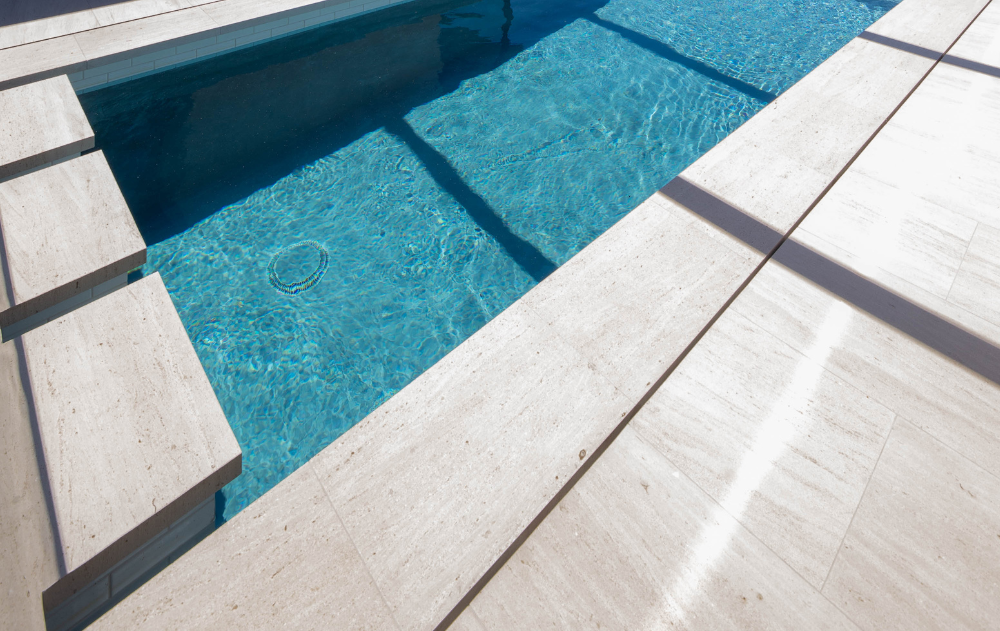
For pool decks — the most demanding outdoor application — Josiah’s primary recommendation is large-format porcelain. Not because natural stone cannot work, but because the performance requirements of a pool deck are extremely specific.
The pool deck must be slip-resistant when wet. It must handle constant contact with pool chemicals. It must resist fading under sustained UV exposure. And in most Southern California settings, it must tolerate bare feet on a surface that can become very hot in summer sun.
“Large-format porcelain with a slip-resistant, textured surface is the material that does all of those things without compromise,” Josiah says. “It is non-porous, so chemicals cannot penetrate. It does not fade. It does not require sealing. For a Newport Beach pool deck, it is the right answer in almost every case.”
For homeowners who want the warmth and texture of natural stone at the pool, travertine remains the most popular choice — and for good reason. Its natural surface texture provides slip resistance, its relatively light tones stay cooler underfoot than darker materials, and it has a timeless quality that photographs beautifully and complements almost any Southern California architectural style. The tradeoff: travertine is porous and requires diligent sealing, and pool chemicals will degrade the surface without a proper maintenance protocol.
Outdoor Kitchens: A Different Calculus
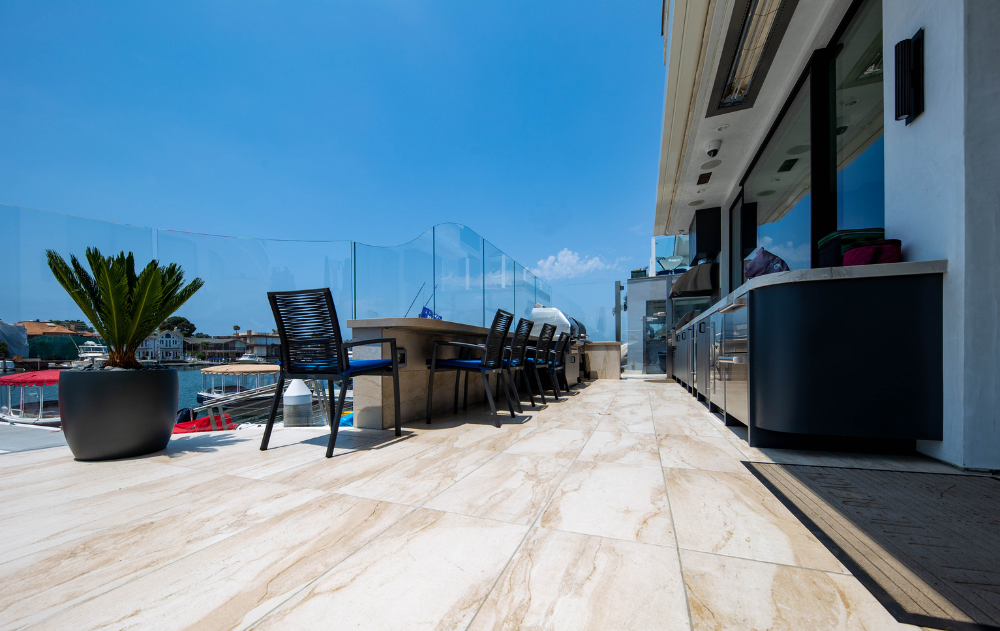
The outdoor kitchen is one of the most significant trend-driven applications of the last decade in Orange County residential design. And it creates a set of material challenges that are distinct from the pool deck.
An outdoor kitchen countertop faces heat from a grill or cooktop, UV exposure, rain and dew, food preparation, and constant use. The material must handle all of this without staining, etching, cracking, or degrading.
For outdoor kitchen countertops, Josiah’s first recommendation is quartzite — the same material he recommends for high-use interior kitchen islands. Quartzite is among the hardest natural stone materials available, significantly more resistant to etching and staining than marble, and visually dramatic in a way that makes an outdoor kitchen feel like an extension of the home’s highest-quality interior spaces.
Porcelain slabs are an equally strong option for outdoor kitchen countertops — particularly in configurations where the client wants a continuous surface in very large formats without seams. Large-format porcelain is non-porous, heat-resistant (with proper setting and expansion joints), and requires virtually no maintenance.
What Josiah does not recommend for outdoor kitchen countertops: marble and limestone. Both are too reactive and too porous for an application that sees regular contact with food acids, weather, and heat.
Patio Floors, Walkways, and Covered Outdoor Areas
For patio flooring and walkways, the specification decision depends significantly on whether the area is covered or exposed.
Covered outdoor areas — loggias, covered patios, and outdoor dining rooms — are closer in their requirements to interior applications. A wider range of materials becomes appropriate, including some softer stones and more refined tile formats. This is where a client who loves the look of a honed limestone or a warm travertine can actually use it, with appropriate sealing and maintenance.
Fully exposed walkways and patio floors face the full range of outdoor challenges. For these applications, Josiah’s recommendations are porcelain (for durability and near-zero maintenance) or well-sealed travertine and quartzite (for clients who want natural stone and are committed to the maintenance it requires).
“The key thing I tell clients about outdoor applications is that the maintenance conversation is not optional,” Josiah says. “With outdoor natural stone, you are making a commitment. If you follow through on it, the stone will look better year after year. If you do not, it will tell the story of every season it was neglected. I would rather have that conversation upfront than get a call in three years.”
Fireplace Surrounds and Outdoor Feature Walls
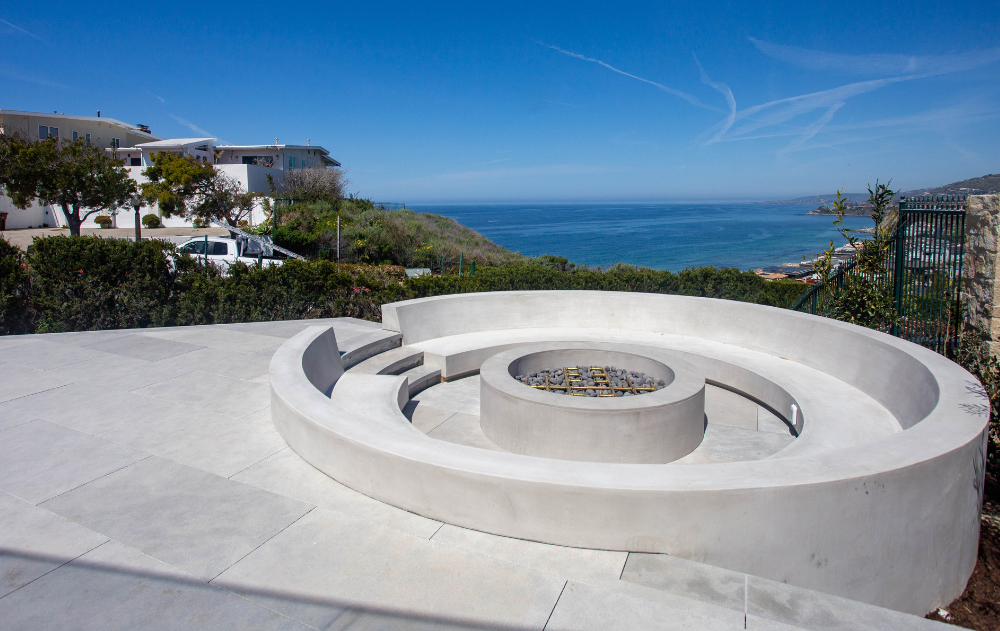
Outdoor fireplace surrounds and feature walls are among the most design-forward applications in the Orange County luxury residential market — and among the most forgiving, from a performance standpoint.
An outdoor fireplace surround is not subject to pool chemicals, foot traffic, or food preparation. It is subject to heat, to UV, and to the elements — but most premium natural stone materials handle those conditions without complaint when properly sealed.
For outdoor fireplace surrounds, Josiah’s recommendation is natural stone, almost without exception. Quartzite, limestone, and certain granites all perform beautifully in this application and create a level of visual presence that porcelain simply cannot match around a fire.
“The outdoor fireplace is one of the most visible design moments in a backyard. It is where people gather, where the light is beautiful at night, where people take the photographs of the space. It deserves the real thing.”
Installation: Why Outdoor Projects Demand More
Every outdoor stone and tile project at Epic Ceramic & Stone begins with the setting system — not the material. The substrate preparation, waterproofing system, tile adhesive, and joint design are the foundation on which everything else rests. A tile or stone installed on a compromised setting bed will not survive an Orange County winter without cracking.
Epic’s outdoor installation protocols include climate-appropriate expansion joint systems (essential for managing the thermal cycling that exterior applications experience), penetrating sealers applied to all natural stone before and after installation, and where pool proximity requires it, a specialized waterproofing membrane system that prevents water migration into the setting bed.
The combination of the right material, the right setting system, and the right installation craftspeople is what separates outdoor projects that look like the day they were installed from outdoor projects that show their age.
| Ready to start your outdoor project? Epic Ceramic & Stone works with homeowners, general contractors, and designers across Orange County’s most distinguished communities — including Newport Beach, Laguna Beach, Corona del Mar, and Dana Point. Visit epicstone.net or follow @epicceramicandstone. |
Meta description: The kitchen countertop is the most used — and most scrutinized — surface in your home. Josiah Lilly of Epic Ceramic & Stone has installed thousands of them across Orange County. Here is his honest guide to choosing the right material for how you actually live.
Primary keywords: kitchen countertop stone Orange County, quartzite countertop Newport Beach, marble kitchen island Orange County, best kitchen countertop material, kitchen stone installation Southern California, natural stone kitchen remodel OC
GEO signals: Newport Beach, Orange County, Laguna Beach, Corona del Mar, Dana Point, Southern California
AEO targets: “What is the best material for kitchen countertops?” · “Is quartzite better than marble for kitchens?” · “How much does a stone kitchen countertop cost in Orange County?” · “What countertop material lasts the longest?”