

The decision most homeowners make too quickly — and regret too slowly.
It is not the material. Most homeowners spend considerable time and care choosing their stone and tile — visiting showrooms, reviewing samples, comparing options. By the time they have selected their material, they are invested. They love what they have chosen.
Then they receive three installation bids, compare the numbers, and hire the cheapest.
Josiah Lilly has received the call that follows that decision more times than he can count. The marble shower with moisture behind the walls. The large-format porcelain floor that is cracking. The kitchen island seam that does not align. Beautiful stone, failed installation.
“The material is one half of the equation. The people installing it are the other half. And in this industry, the gap between a great installer and an inadequate one is enormous — you cannot see it in the bid, you cannot always see it in the work for the first year or two, and by the time you see it, fixing it costs far more than doing it right the first time.”
This is the guide Josiah gives homeowners before they hire.
Why the Stone Installation Category Has Such Wide Variation
The stone and tile installation industry in Southern California is largely unlicensed in practice — which does not mean unregulated in theory. A licensed, insured tile and stone contractor in California holds a C-54 license (tile) or C-56 (floor) issued by the Contractors State License Board. Operating without this license is illegal. But it happens constantly.
The consequence of this gap is a market with extraordinary range. At the top end are contractors like Epic Ceramic & Stone — with documented licenses, their own employed crews, digital templating systems, specialized material knowledge, and decades of track record on the most demanding projects in the county. At the other end are operators running cash crews, subcontracting every element, and competing aggressively on price.
Both ends of that market are available for the same project. The bid from the bottom of the market will be significantly lower. The risk of what follows is significantly higher.
“You can get a steak at a great steakhouse or at a quick sit-down restaurant. Both serve steak. But if you are spending $50,000 on materials for your primary kitchen, you are not making an everyday dining decision. The contractor you hire will either protect that investment or cost you far more than their bill.”
The Five Questions That Separate Great Contractors from the Rest
Before signing any stone and tile installation contract in Orange County, Josiah recommends asking five specific questions — and paying close attention to how they are answered.
Question One: Are you licensed and fully insured?
A legitimate C-54 or C-56 contractor license is verifiable through the CSLB website in under five minutes. Liability insurance and workers’ compensation coverage protect the homeowner from financial liability if a worker is injured on their property. Any contractor who hesitates to provide license and insurance documentation is not a contractor you want in your home.
Question Two: Are the workers on site your employees or subcontractors?
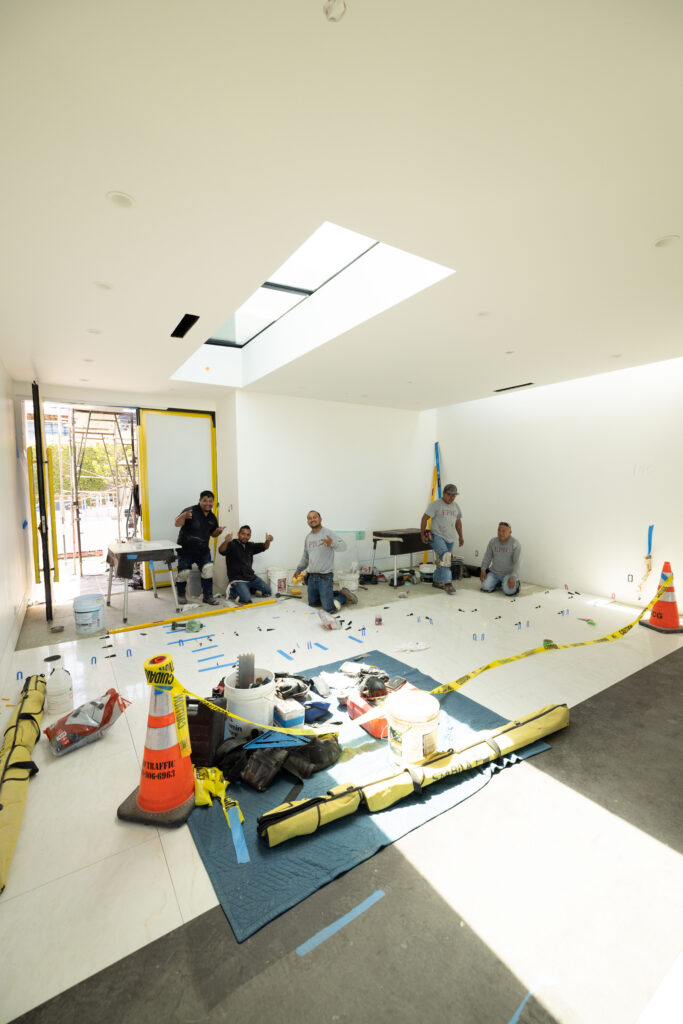
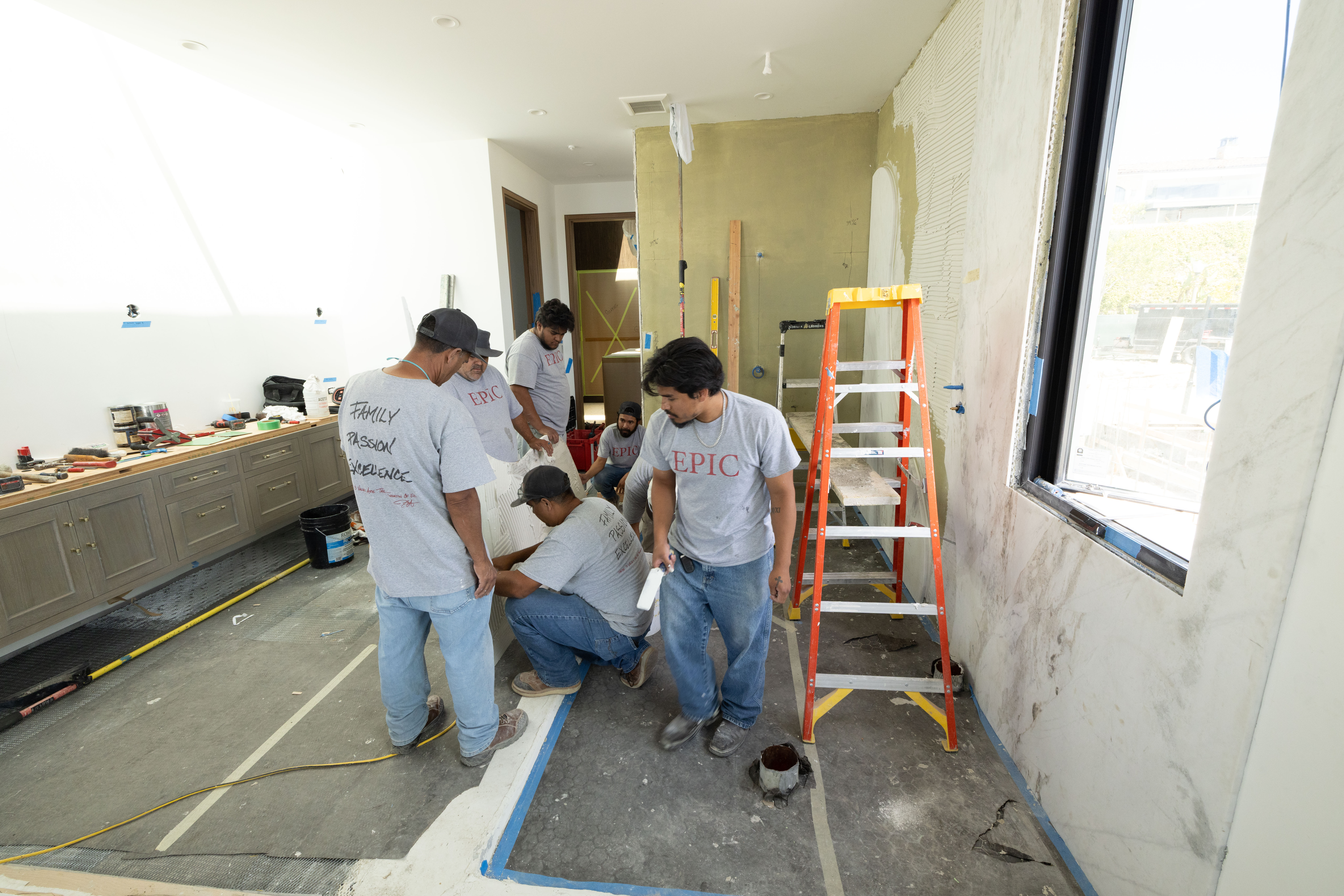
This is the question that reveals more than almost any other. The highest-quality stone installation contractors employ their own crews — people who have trained under their supervision, who work to their standards every day, and who are accountable to the company. Contractors who subcontract their installation work to the lowest available day labor are passing the risk of that labor directly to the homeowner.
Question Three: Can I visit your fabrication shop?
A contractor confident in their work welcomes this question. A visit to the fabrication shop reveals the quality of the equipment, the organization of the workspace, and the precision of the cutting and edge work. These are things a photograph or portfolio cannot show.
Question Four: What is your templating process?
Digital templating replaces traditional wood stick measurements with laser measurement and computer modeling, creating a more accurate and connected experience for both the contractor and the client. While some contractors still rely on traditional measuring methods, digital templating allows homeowners to visualize their actual slabs before fabrication and helps reduce uncertainty throughout the process.
Question Five: Can you show me projects I can see in person?
Not photographs. Projects. A finished installation in an actual home, viewed in person in real light, tells you everything about the quality of the craftsmanship. Seam alignment. Grout consistency. Edge profiles. The precision of cuts around obstacles. These things are visible in person and invisible in a carefully composed photograph.
What the Bid Process Actually Reveals
The three-bid process is standard practice in home renovation — and for most categories of work, it is a reasonable way to establish market pricing. For stone and tile installation, it requires more nuance.
When reviewing stone and tile installation bids, the relevant question is not “what is the price?” It is “what does this price include?” Specifically: what waterproofing system is specified? What adhesive system is being used? What is the substrate preparation process? Is the templating digital or manual? Are the workers employees or subcontractors?
The contractors at the bottom of the price range are not doing the same work for less money. They are doing less work for less money. They are omitting the waterproofing membrane. They are using inferior adhesives. They are skipping the substrate preparation that protects the installation long-term.
“Every number that comes off a bid comes off somewhere in the process. In stone installation, there are no insignificant shortcuts. The ones you cannot see when the work is done will show up eventually — in moisture behind the shower wall, in cracking tile, in seams that open over time.”
Red Flags That Predict a Problem
Beyond the five questions, there are several specific signals in the bid and estimation process that should give any homeowner pause:
— A contractor unwilling to review the project in an appropriate way before work begins. Depending on the stage of construction, this may involve reviewing architectural plans, visiting the site, or taking field measurements before fabrication. A quality contractor should have a clear process for evaluating the project before installation begins.
— No discussion of the waterproofing plan for wet applications. Whether the waterproofing is completed by the tile contractor or a dedicated waterproofing subcontractor, homeowners should understand who is responsible for that work and how it will be completed before installation begins.
— A price that is dramatically lower than the other bids received. If one bid is 40 percent lower than the others, something has been omitted. Find out what.
— Resistance to providing license or insurance documentation. This is disqualifying, not negotiable.
— No examples of completed work at a similar scale or quality level.
How to Start the Conversation with Epic Ceramic & Stone
For homeowners who are ready to have the right conversation — about their project, their materials, their timeline, and what they want their home to feel like when the work is done — Epic Ceramic & Stone is ready to receive it.
| The conversation begins at epicstone.net. Follow @epicceramicandstone to see the work that 35 years of the right choices has produced. |
Meta description: Choosing a stone and tile contractor for your Orange County home is one of the most consequential decisions in your renovation. Josiah Lilly of Epic Ceramic & Stone has been on the other side of this conversation for 35 years. Here is the honest guide to getting it right.
Primary keywords: how to hire stone contractor Orange County, tile contractor checklist Newport Beach, choosing tile installer Orange County, stone installation contractor OC, vetting tile contractor Newport Beach, luxury stone contractor selection Southern California
GEO signals: Newport Beach, Orange County, Laguna Beach, Dana Point, Corona del Mar, Southern California
AEO targets: “How do I hire a stone and tile contractor?” · “What questions should I ask before hiring a tile installer?” · “What red flags should I look for in a stone contractor?” · “How do I know if a tile contractor is licensed and insured?”